The spread of
Christianity throughout Europe in the Middle Ages resulted in a somewhat
catastrophic purge of the insane under the guise of faith – the witch hunts, or
“Burning Times” as modern Wiccans call it (Guiley, 2008; Lewis, 1999), the term
having been coined by the 20th century Wiccan leader, Gerald Gardner
(Golden, 2006; Simpson & Roud, 2000).
Gerald Gardner
According to Millon (2004) and others
(Mackay, 2009), medieval Christian mythology included a belief that there was a
worldwide Satanic conspiracy to destroy Christianity (Bonewits, 2001; Mackay,
1841), and that the agents of this conspiracy were witches, who not only
worshipped Satan (Gurses, 1997), but also engaged in other heinous activities
including murder, cannibalism and sexual orgies (the anxiety over the latter
being provoked by the sexual activities of some monks and nuns (Darton,
1999)). As a result of this misguided
belief, the Inquisition (the Holy Office of the Inquisition of the Roman
Catholic Church, established in 1188 by Pope Lucius III, to prevent the spread
of heretical movements (Lewis, 1999; Nemec, 1974)) was informed in 1233 by Pope Gregory IX to root out witches, heretics
and all other agents of the Evil One (Bailey, 2003a; Guiley, 2008; McBrien,
2006; Porter, 2002). Images of witches riding broomsticks first appeared in
1280 (Ellerbe, 1995).

An early image of a witch on a broomstick
Pope Paul II, in 1468, declared witchcraft a
“crimen exceptum” (Golden, 2006), thus giving ecclesiastical and secular courts
complete freedom in dealing with witches (Nemec, 1974). Not only the leaders of Christianity believed this, but it was also
taken on by the common people, and it was a belief still prevalent in the 17th
century. The Old Testament was often quoted as a rationalisation for these
beliefs, particularly Exodus xii, 18: “Thou shalt suffer no witch to
live”. Zimmermann & Gleason (2000) opine that this passage was originally
worded “Thou shalt not suffer a poisoner to live,”
but that King James I, whose translation of the Bible is the commonly accepted
version, was so scared of witches that he changed the wording to that given
here. This is reinforced by Bonewits (2001) and Golden (2006). King James also
wrote about witchcraft himself, publishing Daemonologie
in 1597 (Guiley, 2008; James VI, 1597).
James I of England
Both Catholics and Protestants believed that witches could invoke demons
to possess others (Bailey, 2003b), and it was the duty of the church (in
whatever form) to force those who were possessed by demons to admit to being
witches and to deliver the names of other witches to the church. This admission
was evinced by torture (Bailey, 2003b; Bonewits, 2001), and once elicited the
punishment for being guilty was usually death, especially by burning at the
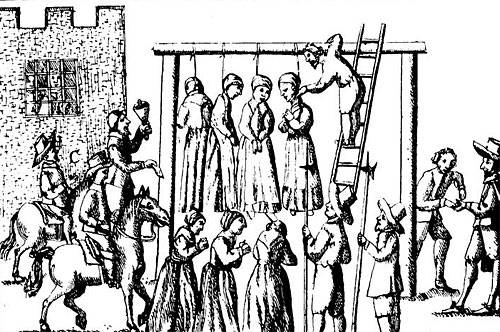
stake (although the English Witchcraft Acts of the 16th century
prescribed hanging as the penalty (Simpson & Roud, 2000)); however, it has
to be said that the religious leaders who recommended such punishment would not
have seen it as such – rather it was seen as a benevolent act that rid the
victim of a possessing demon.
The execution of witches by hanging
It could also be argued that the witchcraft
delusion was the church’s paternalistic means of disempowering women
(Al-Sharif, 2004; Ellerbe, 1995; Golden, 2006; Herzig, 2006; Jackson, 1995;
Schuler, n.d.; Toivo, 2005), as more women than men were accused of being
witches (between 75 and 90 percent of those convicted were female, depending on
place and time (Bailey, 2003a; Bailey, 2003b; Ellerbe, 1995; Stearne, 1648)),
yet the counter argument was that more men than women were bewitched (a
situation that implies female power, anathema to the church). English witches
in particular were often elderly women (Ellerbe, 1995; Fletcher, 1896) who
depended on others for charity, and the thinking was that they were resentful
of those who refused them such charity (Simpson & Roud, 2000), leading them
to utter curses and other magical incantations (Gaskill, 2000).
In 1484 Pope
Innocent VIII, in his bull Summis Desiderentes Affectibus, spoke out against witchcraft and exhorted
the church to stamp the practice out, by whatever means necessary (Bailey,
2003b; Buckland, 1986; Campbell, 1986; Darton, 1999; Ellerbe, 1995; Flinn,
2007; Fulford, Thornton & Graham, 2006; Golden, 2006; Guiley, 2008; Gurses,
1997; Harrison, 1975; Hinshaw, 2007; Levack, 2004; Mackay, 2009;
Maxwell-Stuart, 2001; Millon, 2004; Nemec, 1974; Summers, 1926; Tuke, 1892; Vandermeersch,
1991; Williams, 1865; Zimmermann &
Gleason, 2000).
Pope Innocent VIII
As a result two Dominican (the sect of monks that had come to
administer the Inquisition (Bailey, 2003b; Golden, 2006; Lewis, 1999;
Mackay, 2009)) friars, Johann Sprenger
(1436-95) and Heinrich Kraemer (c.1430-1505) published Malleus Maleficarum (The
Witches’ Hammer), a manual on the detection of witchcraft, the examination
of witches and the legal sentencing of them, first published in 1486 (Bailey,
2003a; Bailey, 2003b; Bonewits, 2001; Buckland, 1986; Colp, 2000; Darton, 1999;
Ellerbe, 1995; Fulford, Thornton & Graham, 2006; Golden, 2006; Guiley,
2008; Gurses, 1997; Harrison, 1975; Hinshaw, 2007; Hoyt, 1989; Kamen, 2000;
Levack, 2004; Mackay, 1841; Mackay, 2009; Maxwell-Stuart, 2001; Millon, 2004;
Nemec, 1974; Pugh, 2001; Vandermeersch, 1991; Williams, 1865; Zimmermann &
Gleason, 2000). Examination of a person accused of witchcraft included a search
for “devil’s stigmata”, insensitive
marks on the skin, such as red spots, ulcers, or depressions, which were
considered proof of having had sexual relations with the Devil (Bailey, 2003b;
Darton, 1999; Ellerbe, 1995; Fletcher, 1896; Golden, 2006; Guiley, 2008; Jones,
1972; Nemec, 1974; Notestein, 1911; Pugh, 2001; Summers, 1926; Williams, 1865).

Malleus Maleficarum
In England the most notorious witch finder was Matthew Hopkins, who proclaimed
himself the “Witchfinder-General” and travelled throughout the land, arranging
executions of witches, particularly in East Anglia (Kamen, 2000; Mackay, 1841;
Simpson & Roud, 2000) in 1645-6, resulting in the loss of over 200 lives
(Bailey, 2003b; Guiley, 2008). Hopkins died in 1647, probably from tuberculosis
(Stearne, 1648), but legend has it that he was accused of witchcraft himself
and was hanged (Guiley, 2008; Kamen, 2000; Simpson & Roud, 2000).
Matthew Hopkins, Witchfinder-General
The Malleus Maleficarum served the Inquisition well
and resulted in perhaps hundreds of thousands of innocent men and women put to
death at the stake, or, in Britain, by hanging (Gaskill, 2000; Golden, 2006; Guiley,
2008; Hills, 1901; Lewis, 1999; Millon, 2004; Regis, 1894). Pet cats were often
killed at the same time as their owner, as the belief was that the feline was a
familiar who helped the witch in her evildoing (Bailey, 2003b; Ellerbe, 1995;
Fletcher, 1896; Golden, 2006), although this practice appears to have been more
prevalent on the mainland of Europe rather than the British Isles (Simpson
& Roud, 2000). Gaskill (2000) suggests that many of the prosecutions for
witchcraft ensued from personal feuds. Many of the successful prosecutions
would have been of people with mental health problems (as mental illness was
seen as being due to possession by demons) – easy prey to accusations of
crop-spoiling, causing illness, shape-changing, controlling the weather, the
“evil eye” and so forth (Bailey, 2003b; Guiley, 2008; Hills, 1901; Notestein,
1911), the sort of behaviours that witches were supposed to demonstrate. This
is borne out by at least one writer of the time, Pierre Pigray of France who
commented on an examination of fourteen people in 1589 in Paris:
We found them to be very poor,
stupid people, and some of them insane; many of them were quite indifferent
about life, and one or two of them desired death as a relief for their sufferings.
Our opinion was, that they stood more in need of medicine than of punishment,
and so we reported to the Parliament. Their case was, thereupon, taken into
further consideration, and the Parliament, after mature counsel amongst all the
members, ordered the poor creatures to be sent to their homes, without inflicting
any punishment upon them. (Mackay, 1841, page 237).
British legislation reflected the Catholic church’s stance,
and a series of Witchcraft Acts were passed between 1541 and 1735, the last of
which banned the practice of judicial murder of those condemned as witches
(Adams, 1889; Buckland, 1986; Dock, 1920; Gaskill, 2000; Golden, 2006; Guiley,
2008; Jones, 1972; Pugh, 2001; Williams, 1865) and suggested that claims of
witchcraft were fraudulent. It was not until 1951 that the last Witchcraft Act
was repealed (Buckland, 1986; Guiley, 2008; Levack, 2004). The last execution
of a convicted “witch” was in 1782 (Golden, 2006; Millon, 2004), and the last
known trial for witchcraft took place in Poland in 1793 (Nemec, 1974). The last
execution of a witch in Britain was in 1727 in Scotland (Guiley, 2008; Levack,
2004; Pugh, 2001; Tuke, 1882).
Not everyone agreed with the purge. For example, in 1460,
Dominican monk and professor of logic at the University of Milan, Girolamo
Visconti (Golden, 2006), admitted in his book on witchcraft that “many men of
learning and authority think that these [witches’] illusions arise from a
melancholic humor, depriving women of reason and free will.”
The Dutch physician Johann Weyer (1515-88) also wrote
against the persecutions (Bailey, 2003b; Colp, 2000; Darton, 1999; Golden,
2006; Guiley, 2008; Maxwell-Stuart, 2001; Porter, 2002; Millon, 2004; Slattery,
1994; Vandermeersch, 1991; Williams, 1865) in his De Praestigiis Daemonum et
Incantationibus ac Venificiis (On the Illusions of the Demons and on Spells
and Poisons), published in 1563. (Sigmund Freud ranked this book among the ten
most important he had read (Golden, 2006)). He believed that melancholy
(insanity) caused many delusions and hysterical “imaginings,” and that “magicians” and “diabolists” were actually
the victims of hysteria or hypochondriasis (Golden, 2006; Kamen, 2000; Levack,
2004; Nemac, 1974). He also stated that “Witches’ experiences are delirious
dreams induced by drugs.” This is pertinent when one considers the so-called
flying ointments of witches. These included extracts from various
hallucinogenic plants (Lewis, 1999), including aconite, belladonna, hemlock,
henbane, wormwood, and mandrake (Bever, 2008; Golden, 2006; Guiley, 2008;
Harrison,1975; Hoyt, 1989; Simpson & Roud, 2000; Summers, 1926).
Furthermore, the ointment was said to have been applied to broom handles
(Bailey, 2003b), which were then inserted vaginally such that the active
alkaloids present in the ointment were absorbed through the mucous membranes.
This practice gave rise to the belief that witches rode broomsticks (Golden,
2006; Guiley, 2008; Harrison, 1975; Pollan, 2001). Weyer has also been
recognized as the first writer to state that suicide is often a manifestation
of despair (Rush, 1988). Because of his antithesis to the witchcraft craze,
Weyer’s book was proscribed by the Catholic church, and Weyer himself was
accused of sorcery (Darton, 1999; James VI, 1597).

Johann Weyer
A third author who spoke out against the witch trials was
the Englishman Reginald Scot (1538-1599) in his The Discoverie of Witchcraft,
which was published in 1584 (Bailey, 2003b; Golden, 2006; Guiley, 2008; Gurses,
1997; Levack, 2004; Maxwell-Stuart, 2001; Porter, 2002; Scot, 1584; Simpson
& Roud, 2000; Williams, 1865). He stated: Alas, I am sorry and ashamed to
see how many die who being said to be bewitched, only seek for magical cures, whom wholesome diet and good
medicines would have recovered. . . These affections tho' they appear in the mind
of man, yet are they bred in the body and proceed
from the humour which is the very dregs of the blood; nourishing those places
from whence proceed fear, cogitations,
superstitions, fastings, labours, and such like.
Shakespeare used Scot’s book as a resource, and James I
ordered the book to be burned (Bailey, 2003b; Guiley, 2008; Gurses, 1997; James
VI, 1597; Kamen, 2000; Simpson & Roud, 2000).
The American colonies did not react as quickly, and in 1692
a hundred and fifty supposed witches were tried in Salem, Masschusetts, with
nineteen hanged (Elder, Evans &
Nizette, 2005; Golden, 2006; Guiley, 2008; Maxwell-Stuart, 2001). Later authors
have theorised that the symptoms displayed by these so-called witches were in
fact due to ergotism (Guiley, 2006).
The Salem witchcraft trial
References:
Adams, W.H.D. (1889). Witch,
warlock and magician: historical sketches of magic and witchcraft in England and Scotland. London,
England: Chatto & Windus.
Al-Sharif, W. (2004). Witchcraft
and the persecution of women. Retrieved from http://www.archive.org/details/WitchcraftAndThePersecutionOfWomen
Bailey, M.D. (2003a). Battling
demons: witchcraft, heresy and reform in the late Middle Ages. University Park, PA: Pennsylvania State
University Press.
Bailey, M.D. (2003b). Historical
dictionary of witchcraft. Lanham, MA: The Scarecrow Press Inc.
Bever, E. (2008). The
realities of witchcraft and popular magic in early modern Europe. Basingstoke,
England: Palgrave Macmillan.
Bonewits, I. (2001). Witchcraft:
a concise guide or which witch is which? Miami, FL: Earth Religions Press.
Buckland, R.
(1986). Buckland’s complete book of
witchcraft. Woodbury, MN: Llewellyn Publications.
Campbell, J.P. (1986). Popular culture in the Middle Ages.
Madison, WI: Popular Press.
Colp, R.
(2000). History of psychiatry. In Sadock, B.J & Sadock, V.A. (eds.), Comprehensive text book of psychiatry. (7th edition). Baltimore, MD.: Lippincott,
Williams & Wilkins.
Darton, K. (1999). Notes
on the history of mental health care. Mind: London. Retrieved from http://www.mind.org.uk/Information/Factsheets/History+of+mental+health/Notes+on+the+History+of+Mental+Health+Care.htm
Dock, L.L. (1920). A short history of nursing from the earliest
times to the present day. New York, NY: G.P.
Putnam’s Sons.
Elder, R., Evans, K.,
& Nizette, D. (2005). Psychiatric and
mental health nursing. Marrickville, Australia:
Elsevier Australia.
Ellerbe, H. (1995). The dark side of Christian history. Berkeley,
CA: Morningstar Books.
Fletcher, R. (1896). The
witches’ pharmacopoeia. Baltimore, MD: The Friedenwald Co.
Flinn, F.K. (2007). Encyclopedia
of Catholicism. New York, NY: Facts on File Inc.
Fulford, B., Thornton, T., & Graham, G. (2006). Oxford
textbook of philosophy and psychiatry. Oxford,
England: Oxford University Press.
Gaskill, M. (2000). Crime and mentalities in early modern
England. Cambridge, England: Cambridge University
Press.
Golden, R.M. (Ed.) (2006). Encyclopedia of witchcraft: the western
tradition. Santa Barbara, CA: ABC-Clio
Inc.
Guiley, R.E. (2008). The encyclopedia of witches, witchcraft and
Wicca. (3rd edition). New York, NY: Facts on File Inc.
Gurses, D. (1997). The Satanic ingredients in the seventeenth
century witchcraft debate. Unpublished Master’s
thesis, Bylkent University, Ankara, Turkey.
Harrison, M. (1975). The roots of witchcraft. New York, NY:
Lyle Stewart.
Herzig, T. (2006). Witches, saints
and heretics. Magic, Ritual & Witchcraft 1, 1, 24-55.
Hills, F.L. (1901). Psychiatry –
ancient, medieval and modern. The Popular
Science Monthly 59, 3, 31-48.
Hinshaw, S.P. (2007). The
mark of shame: stigma of mental illness and an agenda for change. Oxford, England: Oxford University Press.
Hoyt, C.A. (1989). Witchcraft.
(2nd edition). Carbondale and Edwardsville, IL: Southern
Illinois University Press.
Jackson, L. (1995). Witches, wives
and mothers: witchcraft persecution and women’s confessions in seventeenth-century England. Women’s History Review 4, 1: 63-84.
James VI (1597). Daemonologie. Edinburgh, Scotland.
Jones, K. (1972). History
of the mental health services. Balmain, Australia; Law Book Company of Australasia.
Kamen, H. (2000). Who’s
who in Europe 1450-1750. London, England: Routledge.
Levack, B.P (Ed.) (2004). The witchcraft sourcebook. New York, NY: Routledge.
Lewis, J.R. (1999). Witchcraft
today: an encyclopedia of Wiccan and neopagan traditions. Santa Barbara, CA: ABC-Clio Inc.
Mackay, C. (1841). Extraordinary popular delusions and the
madness of crowds. New York, NY: Harmony Books.
Mackay, C. (2009). The hammer of witches: a complete
translation of the Malleus Maleficarum. Cambridge,
England: Cambridge University Press.
Maxwell-Stuart, P.G. (2001). Witchcraft in Europe and the New World, 1400-1800. Basingstoke, England: Palgrave.
McBrien, R.P. (2006). The
pocket guide to the popes. London, England: Harper Collins.
Millon, T. (2004). Masters
of the mind: exploring the story of mental illness from ancient times to the new
millennium. Hoboken, NJ: John Wiley & Sons Inc.
Nemec, J. (1974). Witchcraft
and medicine. U.S Department of Health, Education and Welfare. Retrieved from http://www.nlm.nih.gov/hmd/pdf/witchcraft.pdf
Notestein, W. (1911). A history of witchcraft in England from 1558
to 1718. Washington: American Historical
Association.
Pollan, M. (2001). The botany of desire: a
plant's-eye view of the world. New York, NY: Random House.
Porter, R. (2002). Madness:
a brief history. Oxford, England: Oxford University Press.
Pugh, R.J.M. (2001). The Deil’s ain: the story of witch persecution in Scotland. Balerno,
Scotland: Harlaw Heritage.
Regis, E. (1894). A practical manual of mental medicine. (2nd
edition). Utica, NY: American Journal of Insanity.
Rush, A.J. (1988). Clinical diagnosis of mood disorders. Clinical Chemistry 34, 5: 813-821.
Schuler, R.W. (n.d.). The
persecution of women as witches. Retrieved from http://www.the-night.net/witches/persecution.htm
Scot, R. (1584). The discoverie of witchcraft. From 1886 reprint. London, England:
Elliot Stock.
Simpson, J., & Roud, S. (2000). A dictionary of English folklore. Oxford,
England: Oxford University Press.
Slattery,
E. (1994). To prevent a "Shipwreck
of Souls": Johann Weyer and "De Praestigiis Daemonum." Essays
in History 36, 83-90. Retrieved from http://etext.virginia.edu/journals/EH/EH36/slattery1.html
Stearne, J. (1648). A
confirmation and discovery of witchcraft. London, England: William Wilson.
Summers, M. (1926). The history of witchcraft and demonology.
London, England: Kegan Paul,
Trench, Trubner & Co.
Toivo, R.M. (2005). Women at stake: interpretations of women’s
role in witchcraft and witch-hunts since
the early 20th century to the present. Retrieved from http://www.historians.ie/women/sydneypaperi-raisa.pdf
Tuke, D.H. (1882). Chapters in the history of the insane in the
British Isles. London, England: Kegan Paul,
Trench & Co.
Tuke, D.H. (1892). A dictionary of psychological medicine. Philadelphia,
PA: P. Blakiston Son & Co.
Vandermeersch, P. (1991). The victory of psychiatry over
demonology: the origin of the nineteenth century
myth. History of Psychiatry 2, 8:
351-363.
Williams, H. (1865). The superstitions of witchcraft. London,
England: Longman, Green, Longman, Roberts
& Green.
Zimmermann, D., & Gleason, K.A. (2000).
The complete idiot’s guide to Wicca and
witchcraft. Indianapolis, IN:
Alpha Books.